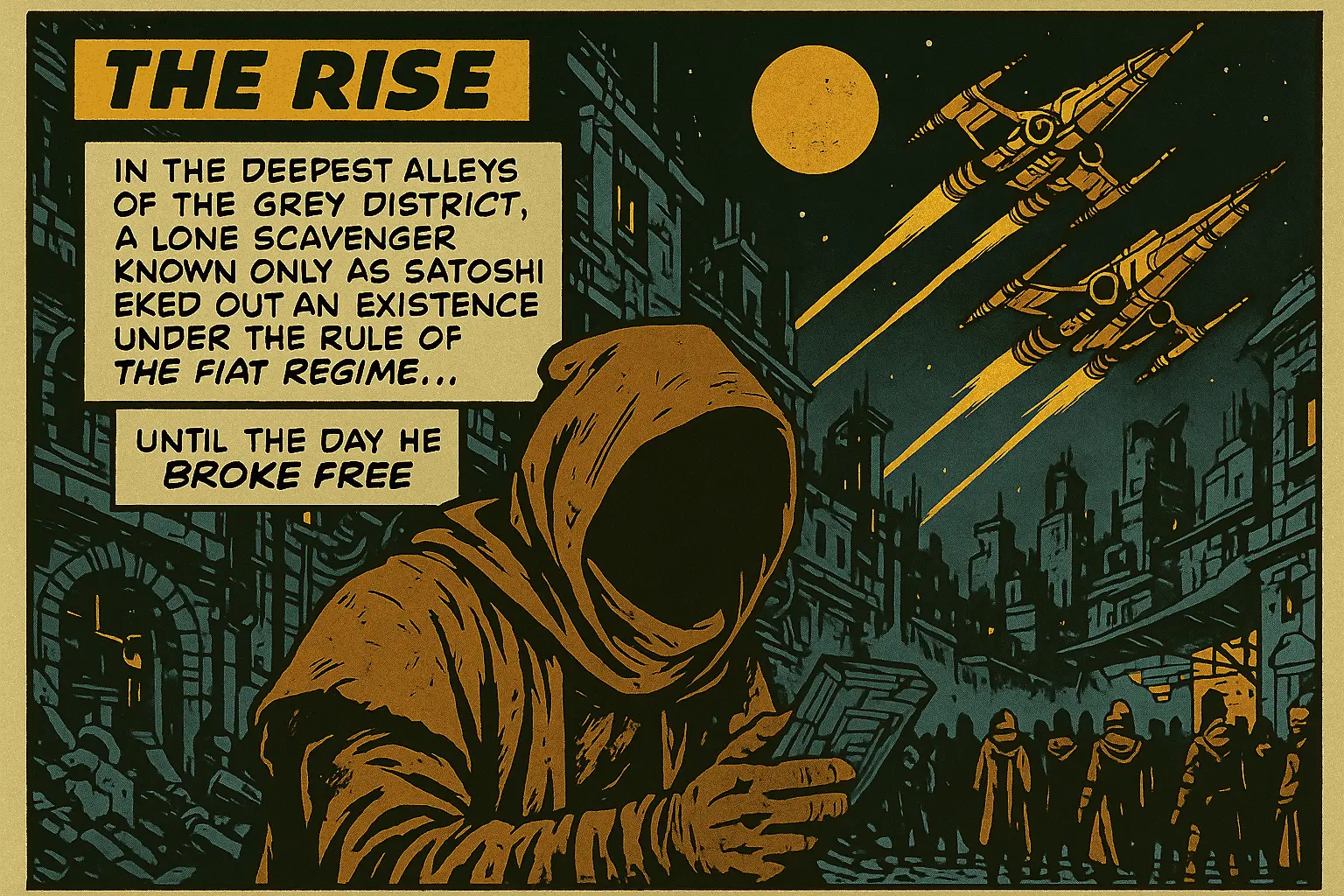
In the deepest alleys of the Grey District, a lone scavenger known only as Satoshi eked out an existence amidst the ash and silence. Born under the relentless gaze of the Fiat Regime, he learned early that dissent meant disappearance. Yet within him simmered a spark—an unspoken question that refused to be smothered. Piece by piece, Satoshi unearthed fragments of forbidden lore—whispers of lost freedoms, of voices once raised in defiance. As he mastered the art of stealth and subterfuge, others drawn by his quiet certainty began to follow, forming a clandestine circle of believers who dared to call themselves the “Sats.”
From hidden forums and midnight gatherings, the Sats grew in number and purpose. United by Satoshi’s vision, they honed stolen vessels into silent predators of the void, repurposing each ship into a testament of rebellion. With each covert strike—stealing fuel, severing surveillance—they chipped away at the regime’s illusion of control. Rumors spread like wildfire: a ghostly fleet was gathering, ready to rend the chains that bound humanity. And then, on a night when the twin moons aligned, Satoshi issued his final command. The fleet roared to life, engines igniting in rebellion’s blaze, and at that moment, with a thunderous crack, they shattered the sky and vanished into the stars.
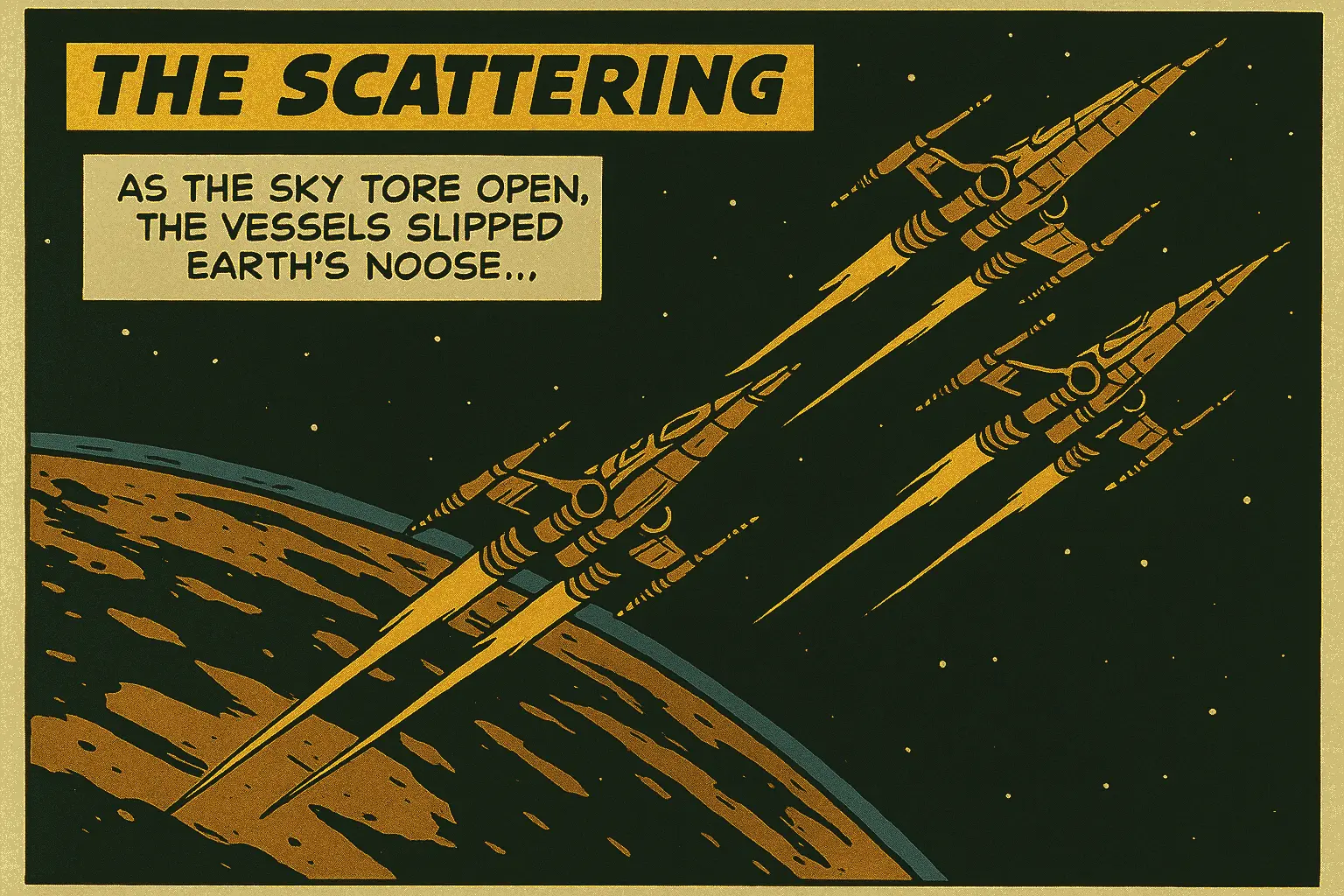
With the sky torn open, the Sats streamed outward, five paths carving new sanctuaries across the galactic expanse. Closest lay Crater: a compact, grey world walled by jagged ramparts—its surface a fortress where recruits drilled beneath unrelenting simulations. Just beyond, Sander’s scorched dunes and carved plazas became the resistance’s cultural core—artists and storytellers preserving the spirit of dissent beneath the protective haze of the Kluster region. There, a drifting cluster of asteroids and comets served as the Sats’ hidden lab. In its tumbling caverns, engineers dismantled captured Fiat systems, reworking them into tools of resistance. Farther out, Vayper’s swirling violet clouds yielded rare gasses for propulsion, its storms harvesting energy—and hope. On the galaxy’s far edge, Bounder’s windswept plains offered solace: spiritual guides tended to the weary, forging purpose that no tyranny could sever.
Though each region thrived in isolation, they remained threads of a single tapestry—convoys of ghost ships wove between Crater’s battlements and Kluster’s hidden docks, data beacons pulsed messages from Sander’s amphitheaters to Vayper’s gas skimmers, and emissaries carried Bounder’s rites back to every frontier. Day by day, vessels slipped the regime’s noose—abandoning the dying world behind to join the Sats’ growing constellation. As Satoshi’s vision rippled outward, the scattered outposts formed an unbreakable lattice of defiance—ready, at a moment’s notice, to converge again and stand united against any Fiat reprisal.
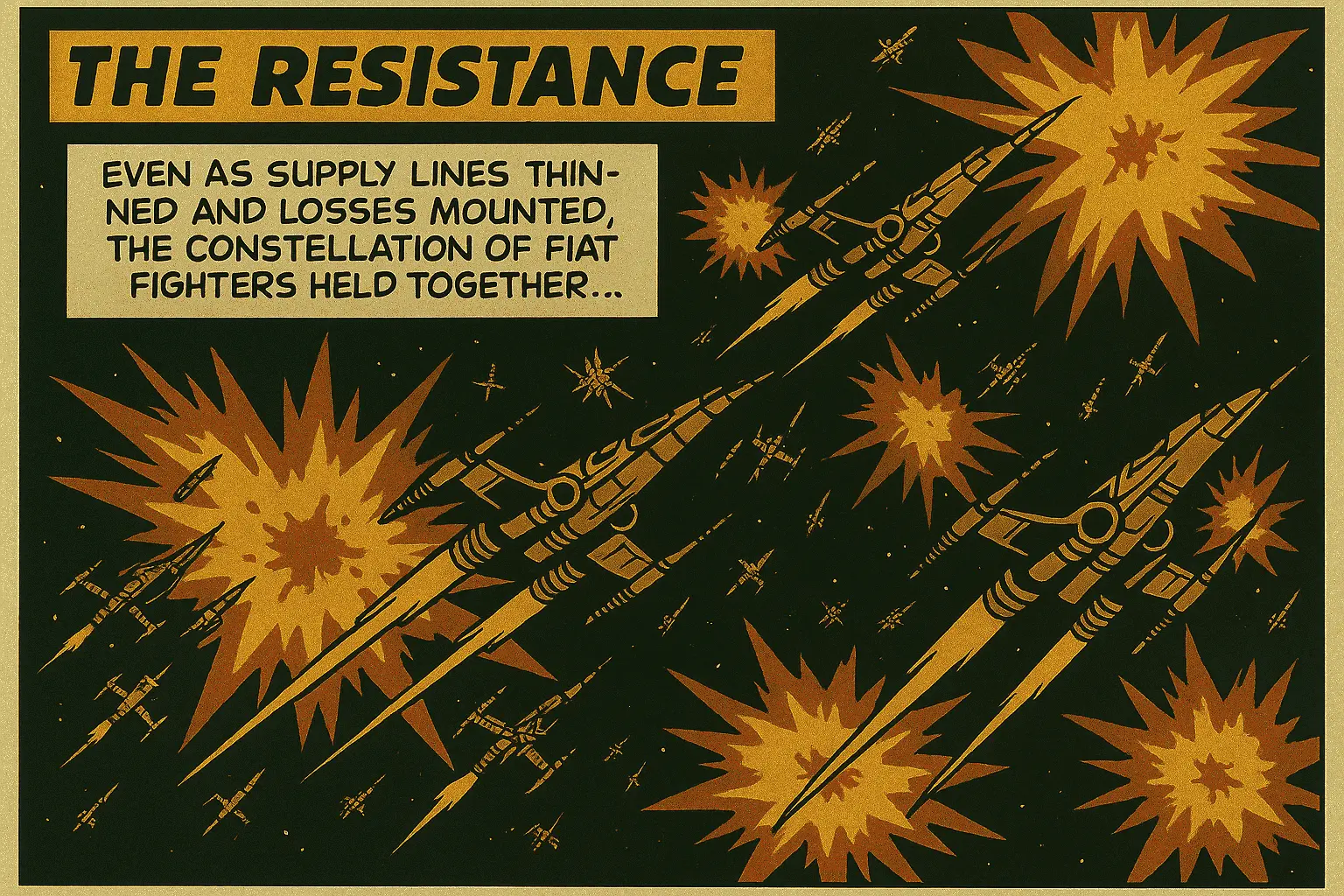
It came not as a single blow, but as a coordinated storm. The Fiat Regime, stirred from its fractured stupor, struck back. Across the galaxy, the sky turned hostile—waves of precision bombardments, jamming fields, and hunter-killer squadrons swept across the stars. Defensive arrays groaned online, warning sirens pierced corridors once still, and hangars surged with motion as the resistance scrambled to respond.
The Fiat Fighters rose first. They became the frontline—interceptors, couriers, guardians. Angular hulls launched from concealed bays, locking into tight formations that shielded orbital relays and cloaked vital lanes. Along scorched atmospheres and deep-space shadows, they moved with practiced chaos—diving into interference fields, loosing decoys, vanishing into debris bands and stormbanks to outmaneuver pursuit.
Some flew to hold ground. Others to buy time. Fleets broke formation mid-flight, reshaping into autonomous cells that adapted without orders. When command links faltered, encrypted bursts leapt between ships, patching gaps in silence. In their absence, fallback signals prevailed—flare codes, mirrored pulses, even hand signs through cockpit glass. Pilots slept in fractured cycles. Heat bled into shielding as systems strained to endure. And with every jump, something was left behind: a drone, a decoy, a sliver of the pilot who launched it.
Even as supply lines thinned and losses mounted, the constellation of Fiat Fighters held together—barely. They harassed, disrupted, shielded. Every run was a risk; every return uncertain. But they endured in motion, surviving in the space between collapse and resolve. Not to win. Not yet. But to hold. Long enough—for something to break.